
WHERE DO PERSONAL VALUES COME FROM?
The concept of personal values is both complex and simple. Complex because these values are likely to have started in our family of origin and have been developed by our life experiences and core beliefs. Simple because it is easy to see how values drive our behaviour.
The beliefs of parents and parental figures shape the early development of our values. These beliefs can be social, political, religious and moral and will be impacted by place, education and social standing. The subsequent values are likely to be how we approached the world and made judgements about good/bad, right and wrong, appropriate and not appropriate. These beliefs and values form our attitude and how we think about people, places and situations.
As we grow and develop, and are exposed to wider influences and experiences, our beliefs, values and attitudes change. As adults we have beliefs, values and attitudes that are developed independently of those of parents and parental figures, as well as those that we choose to keep from those early influences.
Listen to Heather Tierney-Moore talk about her personal values
and the themes that emerged about why values matter in the organisation.
WHY DOES IT MATTER?
It matters because our values drive our thinking (attitude), and our thinking impacts our behaviour.
Going back to your family of origin (whatever that was), what do you see in those webs of relationships?
Undoubtedly you will have contributed to results that nobody wanted, you will have misread situations, and you will have behaved in a specific way because that’s ‘your place’ or that’s ‘what’s expected’.
When you belong to a family, a team, friend’s groups etc, there are unspoken rules: things it’s ok to talk about, things it’s ok to do and the opposite. These expectations create patterns and these patterns inform thinking, communication and the inner voices of fear, judgement and cynicism.
The diagram below is called the Attitude Cycle.
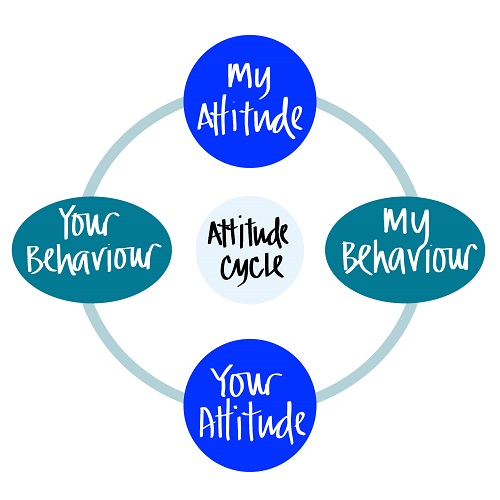
The Attitude Cycle is built on the idea that our behaviour is informed by our beliefs, values and resulting attitudes. That behaviour then influences the attitude of others and in turn their behaviour, as each of us signals and interprets the behaviour of another and that forms the start of the cycle.
If we don’t know and understand each other’s values, we are wandering around on a landscape of assumptions and judgements, missing relationship-building opportunities, and learning. This is not good for any of us in our relationships across our lives, not just at work.